Warning Signs Your Cape Coral Roof Needs Repair (And What They Mean)
17 June, 2025
A homeowner in Cape Coral called me last month about a small water stain on their bedroom ceiling. “It’s only about the size of a dinner plate,” they said. “Do I really need to worry about it?”
Three days later, we were on their roof pulling back shingles to find rotted decking underneath. That small stain? It had been there for months, quietly getting worse while water worked its way through layers of roofing material and into the wood structure of their home.
Here’s what I’ve learned after nearly 30 years working on roofs in Cape Coral, Fort Myers, and Lee County: Your roof shows clear warning signs when something’s wrong. The problem is, most people don’t know what to look for, or they see the signs and figure they’re not urgent enough to deal with right now.
I’m going to walk you through the real warning signs of roof damage, what they mean, and when you need to take action. Because catching problems early is the difference between a $400 repair and a $12,000 replacement.
Ceiling Stains: The Warning Sign You Can’t Ignore
Let’s start with the most obvious one, because it’s also the one people dismiss most often.
You notice a brownish stain on your ceiling. Maybe it’s in the corner of a room, or around a light fixture, or spreading out from where the ceiling meets the wall. It’s not dripping. It’s not even wet anymore. Just a stain.
Here’s what that stain is telling you: water got through your roof, soaked through your attic insulation, and made it all the way to your ceiling drywall. That doesn’t happen from one rain shower. That’s the result of water getting in the same spot over and over until it finally showed itself inside your house.
By the time you see a ceiling stain, the damage is already worse than you think. The roof decking where the leak started? Probably compromised. The insulation in your attic? Soaked and compressed, which means it’s not insulating anymore. The drywall you’re looking at? That might need replacing too.
What to do: Don’t wait. Call a roofer to trace the leak and assess the damage. Even if the stain is old and dry, the problem that caused it is still there. It’ll leak again next time it rains hard, and the damage will keep spreading.
In Cape Coral, with our afternoon thunderstorms rolling through all summer, a small leak becomes a big problem fast.
Granules in Your Gutters: Your Shingles Are Breaking Down
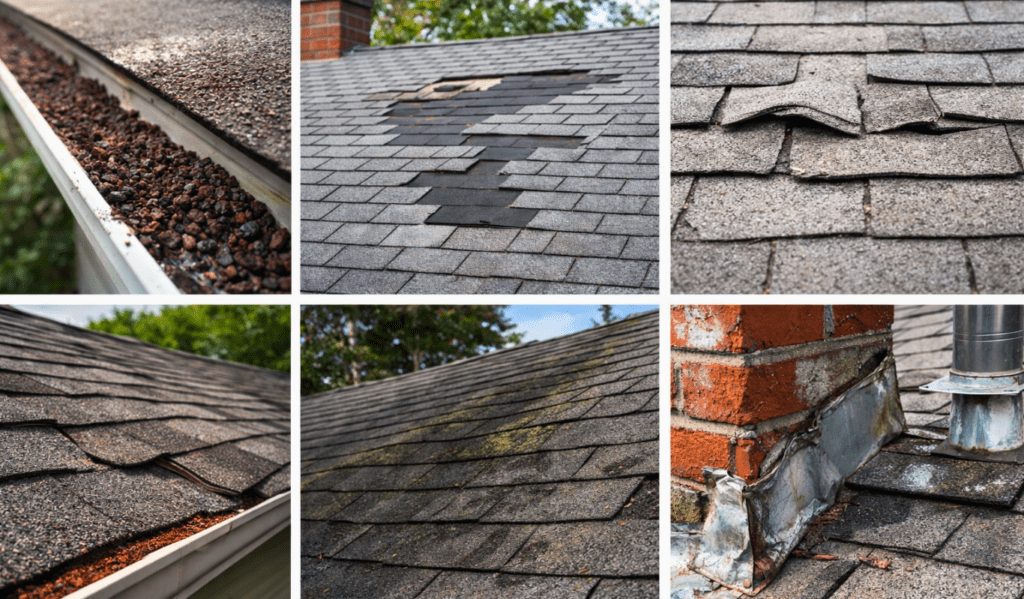
Walk out to your gutters after a rain and take a look. See what looks like coarse sand or grit collecting at the bottom of the downspouts? Those are shingle granules, and finding them is not a good sign.
Asphalt shingles are covered with tiny granules that protect the underlying material from UV damage. When shingles are new, they hold onto those granules tight. As they age, especially under Florida’s intense sun, they start losing them. First a few here and there, then more and more until whole sections of shingle are exposed.
Once the granules are gone, the asphalt gets direct sun exposure. It dries out, cracks, and fails. Your roof ages faster once it hits this stage.
What to do: If you’re finding just a small amount of granules (like a handful), that’s normal aging. Keep an eye on it. If you’re finding cups full, or if it’s happening consistently after every rain, your shingles are deteriorating. Get an inspection. You’re probably looking at replacement in the next year or two, and knowing that now lets you plan and budget instead of scrambling when a leak forces your hand.
Missing Shingles: The Damage You Can See From the Ground
After a storm rolls through Cape Coral, take a walk around your house and look up at your roof. Can you see spots where shingles are missing? Areas where the black underlayment is showing through? Edges where shingles have lifted or blown off?
Missing shingles are a problem for two reasons. First, obviously, they’re not protecting that section of your roof anymore. Water can get straight to the underlayment and decking. Second, once shingles start coming off, more will follow. The wind gets under the edges of adjacent shingles and the problem spreads.
A few missing shingles after a major storm isn’t unusual. But if you’re losing shingles every time we get strong winds, that tells you the adhesive has failed. That’s an age issue, and it means your whole roof is getting brittle.
What to do: If you’ve lost a handful of shingles in one area, that’s usually a straightforward repair. We replace the missing shingles, check the underlayment, and seal everything back up. But if you’re missing shingles in multiple areas, or if this keeps happening, you’re past the point where repairs make sense. The roof system is failing.
Cracked, Curled, or Buckled Shingles: Age and Weather Taking Their Toll
Get up on a ladder (safely) or use binoculars from the ground and look at the condition of your shingles. Are they lying flat and uniform, or are you seeing problems?
Cracked shingles: Straight lines or spiderweb cracks running through shingles. This happens when they dry out and lose flexibility. Once they crack, water gets in.
Curling shingles: The edges curl up or the centers start to cup. This is UV damage and age. Curled shingles let water run underneath them instead of shedding it off the roof.
Buckled shingles: Shingles that look wavy or distorted, like they’re not lying flat against the roof deck. This can be an installation problem, moisture in the decking, or extreme heat causing the materials to warp.
All three of these conditions mean the shingles aren’t doing their job anymore. They’re not creating a watertight seal, and they’re vulnerable to wind damage.
What to do: A few cracked shingles in one section can be replaced. Widespread curling, cupping, or buckling across most of your roof? That’s the end of the line for that roofing system. You need replacement.
Algae Streaks and Dark Stains: More Than Just Cosmetic
Look at roofs around Cape Coral and you’ll see black or dark green streaks running down from the ridge. A lot of homeowners think that’s just dirt or mildew. It’s not. That’s algae growth, and in Florida’s humid climate, it’s extremely common.
Here’s why it matters: Algae holds moisture against your shingles. That constant moisture accelerates deterioration. The shingles break down faster, granules wash off sooner, and the lifespan of your roof gets shortened by years.
Plus, algae growth is a sign that your roof is old enough for organic material to take hold. It usually starts showing up around the 10-year mark on roofs in our climate.
What to do: If the algae is light and your roof is otherwise in good condition, you can have it cleaned. There are treatments that kill algae without damaging shingles. But if the streaks are heavy and you’re also seeing other signs of age (granule loss, curling, etc.), cleaning is just cosmetic. The underlying problem is an aging roof.
Sagging Roofline or Soft Spots in the Attic: Serious Structural Issues
This one’s less common, but it’s serious when it happens. If you look at your roofline from the street and it’s not straight (there are dips or sags), or if you go up in your attic and feel soft spots when you step on the decking, you’ve got structural damage.
This means water has been getting into your roof decking for a long time. Long enough to rot the wood. The decking is what supports your entire roofing system. If it’s compromised, you can’t just slap new shingles on top. You need to replace the damaged decking first, then rebuild the roof system on top of it.
What to do: Call a roofer immediately. This is not something you wait on. Sagging or soft spots mean the structural integrity of your roof is compromised. If it gets worse, you could be looking at a partial roof collapse, especially if a heavy storm dumps water weight on an already weakened area.
Flashing Problems Around Chimneys, Vents, and Skylights
Flashing is the metal material that seals the joints where your roof meets vertical surfaces (like chimneys) or around penetrations (like vents and skylights). It’s critical for keeping water out, and it’s also one of the most common failure points on a roof.
Look for:
- Rust or corrosion on metal flashing
- Gaps where the flashing has pulled away from the surface
- Cracked or missing caulk around flashing
- Water stains on the ceiling near chimneys or skylights
Flashing fails faster than shingles in many cases, especially in Cape Coral where salt air accelerates corrosion.
What to do: Flashing problems are usually repairable, even on older roofs. We remove the old flashing, check for water damage underneath, and install new flashing with proper sealant. It’s a targeted fix that solves the problem without requiring a full roof replacement (unless the roof is already at the end of its life for other reasons).
When to Call for a Roof Inspection in Cape Coral
Here’s my straightforward advice after three decades in this business: If you’re seeing any of these signs, get an inspection. Not next month. Not after the next storm. Now.
You should definitely call if:
- Your roof is 12+ years old and showing any warning signs
- You’ve got active leaks or ceiling stains
- You’re missing shingles or seeing widespread cracking/curling
- You found soft spots in your attic
- You just went through a major storm
You should probably call if:
- Your roof is 8-10 years old and you’re seeing heavy granule loss or algae
- You’ve never had your roof inspected
- You’ve noticed any changes in how your roof looks
- Your neighbors are getting new roofs (if they were all built around the same time, they’re all aging at the same pace)
A professional inspection shows you what you can’t see from the ground. We check every section, look at the underlayment, inspect flashing, examine the decking from inside your attic, and give you a complete picture of your roof’s condition.
At Charlie’s Roofing, we don’t charge for inspections, and we’re not going to pressure you into unnecessary work. We’ll show you exactly what we found, explain what it means, and give you options. Sometimes that’s a small repair. Sometimes it’s planning for replacement in the next year or two. Either way, you’ll know where you stand.
What Happens If You Ignore the Warning Signs?
I’ve seen this play out too many times. Someone notices a small leak, sees some missing shingles, finds granules in the gutters. They figure it’s not urgent. They’ll deal with it later.
Then later comes during a major storm. The small leak becomes a big leak. Water pours into the attic, soaks the insulation, damages the ceiling, runs down the walls, ruins flooring. What could have been a $600 repair turns into $8,000 in roof work plus another $5,000 in interior repairs.
Or they ignore the signs until the roof is so far gone that a full replacement is the only option, and it happens at the worst possible time financially. No chance to save up, no time to get multiple quotes, just emergency work that needs to happen immediately.
Your roof doesn’t get better on its own. Small problems become big problems. Cheap fixes become expensive replacements. The best time to deal with roof damage is when you first notice it.
Why Cape Coral Homeowners Trust Charlie’s Roofing
We’ve been working on roofs across Cape Coral, Fort Myers, and Lee County for nearly 30 years. In that time, we’ve inspected thousands of roofs and we’ve learned to spot problems early, before they turn into disasters.
When you call Charlie’s Roofing, here’s what happens: We schedule a thorough inspection at a time that works for you. We climb on your roof, check every section, look in your attic, and document what we find. Then we sit down with you and explain it in plain language. No jargon, no scare tactics, just facts.
If you need a simple repair, we’ll tell you that. If you need to start planning for replacement, we’ll tell you that too. We’ll give you a detailed estimate, answer all your questions, and let you make the decision that’s right for your home and budget.
Our team is licensed, insured, and certified to install TAMKO materials built specifically for Florida’s climate. We’ve been in business this long because we treat people right and we stand behind our work.
Most of our customers come from referrals. Someone we did work for tells their neighbor, who tells their friend, who calls us. That’s the reputation we’ve built, and we protect it by doing honest work every single day.
Seeing signs of roof damage? Don’t wait for it to get worse. Call Charlie’s Roofing today for a free inspection. We’ll show you exactly what’s happening with your Cape Coral roof and give you straight answers about what needs to be done. No pressure, no runaround, just honest advice from people who’ve been doing this work in your community for decades.